Hedonic Intelligence · Hospitality asset intelligence Porto · Worldwide reads

The read under the rating.

Most tools count what guests mention. We read what they mean — every review, in any language, to the bottom — and hand you the asset-side decision a rating average hides. On any property, without operator cooperation.

Discuss a scoped read No demo · project-priced · two assets you name, €4,000, 14 days · MSA / DPA on request
01 · The read

A category dashboard counts what guests mention.
We read what they mean.

A rating average and a category-sentiment tool tell you guests talked about breakfast, and tag it amber. They can't tell you which kind of thing it was — and that is the part that moves the asset.

01An isolated complaint — or a structural pattern.
02A guest who will come back — or one who quietly won't.
03A recovery that worked — or one buried in a polite reply.

Those three distinctions are the lens. Each review is read end to end — over a hundred structured fields, in its original language — then read again as a set. Everything below is that read, anchored to the sentence behind it.

02 · One review, read to the bottom

What a tool tags amber, read in full.

One real public review. A category tool returns three negative tags and moves on. Hover any highlighted phrase — the structured field it produces lights up. The same words, read to the bottom, are a decision.

One public review · hover to inspect

Structured fields0 extracted

What a category tool returns

A low score and three tags. They tell you it went wrong — not what it costs, or what to fix.

What the read returns

0 structured fields from one review · hover to inspect Source language preserved — no translation step
03 · The cohort · a worked example

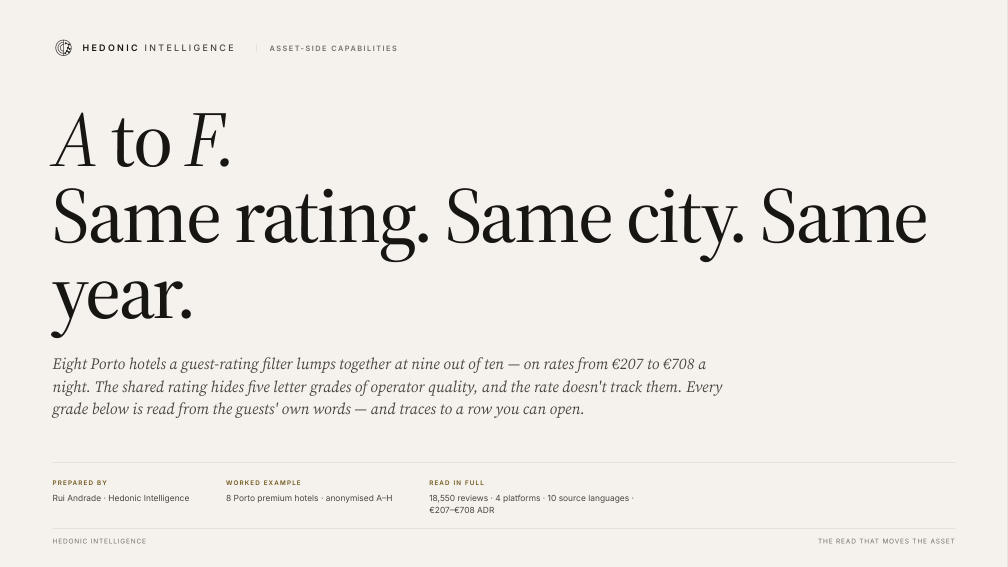
Eight Porto hotels. One rating, five operator grades — and the rate doesn't track the grade.

All eight cluster at roughly nine out of ten on guest rating — a search filter lumps them together. The read grades operator quality A–F against the cohort, beside the rate each one charges. Anonymised A–H; every grade traces to the guests' own words.

Hotel ADR NLS Operator culture Service recovery Repeat guests Overall
Hotel B€679+50AABA
Hotel A€520+45AAAA
Hotel G€249+33BCCB
Hotel C€268+37CCCC
Hotel D€248+25CDDD
Hotel F€207+35DCCD
Hotel E€592+41CDD ↓D
Hotel H€708+18FFFF

8 Porto premium hotels (upper-upscale to luxury) · 18,550 reviews · all clustered at ~9/10 guest rating · grades are cohort-relative. ADR = average offered nightly rate. NLS = net loyalty score (−100 to +100), a strict-language read of repeat intent. D ↓ marks a property declining since an ownership change. The set's two highest rates sit at opposite ends of the grade.

04 · Worked findings

Three reads a rating average can't produce.

Each finding traces to the verbatim behind it, carries its window and sample size, and closes in a decision the right seat can act on.

Hotel H · the rate the experience doesn't cover
F
The highest rate in the set (€708), on the lowest loyalty (NLS +18) and the most guests stating they won't return.
Friction is resolved 3.3% of the time (12 of 369 events; Wilson 95% CI 1.9–5.6%) against a 6.9% cohort baseline — roughly half the cohort rate. Rate is being extracted without the retention to sustain it.
The verbatim behind the grade
EN · theft event · manager refused to call police"The receptionist was smirking about the theft."
EN · 2025 · recent"The so-called manager couldn't have been more unhelpful — doesn't care."

Every percentage carries a Wilson 95% CI and a row count; every quote is row-cited on the engagement deliverable.

The decision: ADR €708 operator replacement, or a rate reset — the five-year question is whether that rate survives the retention, sized against the asset's NOI.
Hotel E · the decline before the rating
−13pp
The last six months sit 13 points of net loyalty below the property's prior baseline — strict NLS, 154 recent reviews.
Repeat guests at an acquisition target are the leading-edge signal — and they date the turn in their own words. The read tracks prior-versus-current per aspect, before any operating report you'd see in diligence.
The verbatim behind the read
EN · 2024 · row-cited"The new owner of just 9 months… lacks all nuance and love of a good hospitalitarian."
JA · repeat guest · six-year comparator6年前に滞在した時から考えると朝ごはんがよくなかった"Compared with my stay six years ago, the breakfast was not good."

Repeat guests identified by comparator language; window and n labelled on every shift claim.

The decision: ADR €592 pre-acquisition diligence and management-contract renewal — size the operator-quality discount against the bid, before the slide reaches the rating.
The cohort · advocacy concentration
+44–60pp
Reviews that name a staff member are 44 to 60 points more likely to carry explicit advocacy than reviews that don't — every hotel in the set.
When guests rave, they rave by name. Advocacy concentrates around a handful of named individuals — so the read shows where the goodwill actually sits, and where the concentration risk is before it walks out the door. A read no rating average can produce.
Why it matters to the asset
Retention leverThe people guests come back for are nameable — and protectable.
Key-person riskWhen one of them leaves, a measurable share of the asset's advocacy is exposed.

Association, not a causal claim — verified across all eight hotels, each above the sample floor (Newcombe 95% CIs).

The decision: know who the guests come back for — protect, reward and cover them deliberately, and price the key-person risk into the operator assessment.
05 · From a read to a number

Every finding closes in a number you can defend.

We don't hand you a sentiment score. We hand you a decision — and the figure behind it, translated on your ADR with the anchor named, so your analyst can check the math.

THIS COHORT ADR €207–€708 RevPAM €5–€19/m² The money layer isn't an add-on — it's the rate every finding lands on.
1
The cohort that leaves in silence → a retention envelope

Finding6.8% of repeat-guest reviews say "worse than last time"; 302 guests state outright they won't return — yet many still rate 8/10, so the operator's average reads fine.

BridgeLost repeat room-nights × your ADR × repeat-guest lifetime value. Repeat revenue carries near-zero acquisition cost — the most expensive kind to lose.

≈ €100–180K / yr · illustrative on a 100-key asset at €250 ADR · anchor: room-night loss

DecisionSize the retention envelope and act before the rating moves.

2
Advocacy that lives in named people → key-person risk

FindingReviews naming a staff member are 44–60pp more likely to carry explicit advocacy. The goodwill concentrates around a handful of people.

BridgeWhen a named advocacy-driver leaves, a measurable share of return intent is exposed — a cost no rating average can see.

DecisionProtect and price the people guests come back for.

What's on the read — and what we won't fake

The read shows the decision and the real rate. Your asset-specific € is computed on the paid deliverable, on your actual ADR, occupancy and repeat-rate. We under-claim on purpose — the number you can put in a memo beats the number that looks good on a slide.

06 · Where this fits

They count concepts. We read meaning.

STR covers the market; the operator's reputation tool covers the rating. We sit on the other side of the table — the why under the rating, for the seat deciding on the asset.

Them · operator-side reputation tools

The reputation & ops layer.

Buyer: GM, front office, brand reputation manager. Job: respond to reviews, raise the score, train the team.

  • SAASPer-property monthly subscription; the hotel is the customer.
  • DATAAggregate scores and category sentiment; single-number indices.
  • FORMAn always-on dashboard the team logs into.
  • NEEDSYour own property, as a paying client.
Us · Hedonic Intelligence — asset-side

What lands in the underwriting file.

Buyer: asset manager, transaction advisor, operator-selection advisor, owner. Job: decide on the asset — buy, hold, swap, intervene.

  • MODELProject-priced engagement, designed to drop into an investment memo.
  • DATAMeaning read from the prose — which cohort leaves in silence, which staff carry advocacy, what moves before the rating.
  • FORMOne designed PDF per engagement — the product is the read, not access.
  • NEEDSNothing from the hotel. Any property, from public reviews — yours, a rival's, a target.
07 · The deliverable

A PDF your committee will actually read.

The cohort above, as the read ships it: the grade, the verbatim behind it, the decision behind each finding, and a labelled confidence band on every claim. Asset-side or operator-side, calibrated to your seat.

Hedonic asset-side capabilities deck — cover slide
Porto premium cohort · capabilities deck · 16:9 Open the full deck ↗
08 · An honest perimeter

What it is — and what it isn't.

Where the read works

No operator cooperation. No PMS feed, no NDA, no site visit — public reviews only. That's what lets us read a rival or a target you have no relationship with.

Periodic, by design. Continuous monitoring of your own book is the operator platform's job. We are the periodic deep read it can't run — on targets, on rivals, on operator-transition deltas.

What reviews don't capture — and what we won't claim

We name the lever and the decision; we don't cost the build. That's your cost engineer. And whether your team executes is your call.

A thin finding stays directional. Anything resting on a handful of reviews is flagged, never sold as fact — every shift claim carries its window and its n.

STR covers the market; ReviewPro covers the rating. We're the why under the rating — which cohort is leaving in silence, which named staff carry advocacy, which operational change shows before the rating moves. And we don't need the hotel as a client — we read any property from public data, including rivals and targets. It's closer to an operational X-ray than a reputation score.
For a handful, yes. What reading by hand can't do: tell you whether a property's friction is 4× the cohort or within noise (every claim carries a sample size and a 95% confidence interval); resolve 50–100 named staff by advocacy across thousands of reviews; or catch a repeat-guest drift months before the rating moves. We read 18,550 the way you'd read 20 — then read them as a set.
They're self-selected, and we treat them that way — anything thin is flagged directional, never sold as fact. We're not claiming reviews are ground truth; we're reading the meaning in what guests chose to write, at a depth that separates a structural pattern from noise.
Public reviews on the major booking and travel platforms. No PMS feed, no operator cooperation, no personal data beyond what the guest already published. DPA, sub-processor register and an IT-security data-handling sheet are available on request for institutional procurement.
A single PDF: the cohort-relative grade, the verbatim behind every finding, the decision behind each, and a labelled confidence band on every claim. First engagement is a two-asset pilot — €4,000, 14 days, deliver-first, NET-30. And you're the judge: if the read doesn't surface something your operator's reporting hasn't, you don't pay — no arbitration. Standard reads are €3,000 per property.
09 · How it works

From brief to deck in 10–14 days.

Four steps. Each one named, scoped, and dated. No sales calls required.

01Brief

The asset, the question, the peer set.

You send the property (or portfolio), the question the deck should answer, and a peer set if you have one. We propose one if you don't.

Same day · async
02Scoping

Engagement note in two business days.

One page: scope, peer-set confirmation, deliverable shape, fixed price, dates. You confirm or adjust.

Within 2 business days
03Delivery

One designed PDF deck.

Anchored on the agreed peer set, calibrated to the question. No raw extracts — the deck is the deliverable.

10–14 days from brief
04Refresh

Recurring cadence (optional).

For portfolio mandates: the same deck refreshed quarterly, or anchored on diligence windows. Same engine, same definitions.

On agreed cadence
10 · The team

Two founders. One read.

Rui Andrade

Co-founder · Technical

MSc in Informatics Engineering, University of Porto. Built the extraction pipeline and the read end to end — he has personally read more hotel reviews into structured data than anyone should admit to.

José Andrade

Co-founder · Research

PhD candidate in hotel intelligence, University of Vigo (Spain); 26 years in industry before hospitality research. Calibrates the read against how hospitality markets actually behave, and owns the case methodology behind each engagement.

11 · Engage

Name an asset. Get the read.

The next step is a scoped read on a property of yours — or a rival, or a target — anchored on its actual peer set.

Tell us who you are, the asset, and the question the deck would answer. We reply within two business days with a scoped engagement note and timing.

No demos · no free property analyses · two assets, €4,000, you're the judge

Received — we'll reply within two business days.
Couldn't send — please email ruibrogandrade@gmail.com directly.